Showing posts with label Saskatchewan. Show all posts

Monday, March 14, 2011

Robsart, Saskatchewan: A Ghost Town on Google Street View

I'm just fascinated with the idea of ghost towns, entire communities that have been abandoned for one reason or another. They make for gorgeous, eerie photos - history, preserved but still decaying. Buildings where people once lived, laughed, loved... now vacant and overgrown. It's romantic, even as it's eerie. The most romantic things are eerie, anyway.

So Robsart, Saskatchewan is one. One of many - the Prairies are dotted with similar places, erected for different reasons and abandoned for different reasons still. Robsart is probably one of dozens. Anonymous, really... except for one thing: Google Street View has sent its cameras through. So now, the most valuable thing Google Street View does - giving you the sense of what it's like to walk streets you'll never see in person - can be applied to a ghost town as well. Let's go for a stroll...

(Note, as always these pictures get bigger and sadder if you click on them.)


Pictures of ghost-towns always have a kind of "The Day After"-style post-nuclear gloom to them. This building was clearly never a very impressive building, but now, in its state of disrepair, it's just sad.


This one was a bit nicer. These people were richer, I suppose. Notice how they left curtains up. I imagine they left saying they'd return one day, or that they'd use it as a summer house or something.


Not here, though. These people cleared out for good. Didn't even bother to close the door on the way out. Though I don't know if this used to be a house or not. It's huge, and look at all those 'vintage cars' abandoned back there. Like everyone was at a weekend hoedown when the bomb fell.


More abandoned cars. Mind you, abandoned cars sitting in fields is a pretty common phenomenon in every rural community, isn't it?


Maybe not like this, though. Threshers and... er, I don't know the names of farming equipment. But there is sits. Some of it is seemingly of a newer vintage, isn't it?


Apparently, this used to be a hospital. I can't say that for sure looking at it, though: it could be a very large dwelling, it could be a schoolhouse... who knows. It's nothing but rotten wood now, anyway, and it looks thoroughly emptied out.


I call this the 'corner store', but I have no idea what it really was. I wonder if that star's a Christmas decoration, and if it just happened to be a December when they cleared out. It kind of looks like there might still be products on display inside.


Clear what this used to be, though, eh? It's tough to guess the vintage: this looks positively Wild-West, but I doubt it's quite so old. Maybe that's when the lumber company was founded, and they used it for decades after without ever changing the sign.
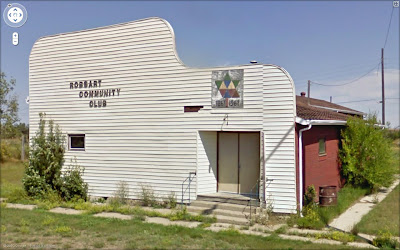

This one is absolutely gorgeous: a 1960s igloo-style façade hiding a sadly generic red building. Who knows what community activities this sad little building, with its solitary tiny front window, once held. But the Canadian Centennial logo establishes the vintage more exactingly. Whenever Robsart was abandoned, it was sometime after 1967. Of course, when I say 'abandoned'...


...Robsart hasn't been completely abandoned. Here's a cow in the middle of the detritus. Must be lots to eat around here.


And I'm not just talking about cows either. Wikipedia reports that Robsart has a population of nine. For some reason, I find this creepier than the thought that it had been completely abandoned: that people still live, like squatters in a graveyard, surrounded by the ghostly detritus of the community that once was.


Or even somehow attempt to eke out a business. This, the painted sign indicates, is 'Robsart Art Works', presumably someone's workshop studio. Several signs around town advertise this site, probably for the benefit of ghost-town adventurers. But it's tough to imagine this poor person gets much business. Although I imagine living in Robsart gives her (for some reason I presume it's a her) a fair amount of inspiration.

Sunday, November 7, 2010

Progressive Talking Point: Saskatchewan

When the Conservative Party was founded in 2002, the House of Commons still reflected the results of it 2000 election. In 2000, the Canadian Alliance, successor to the Western populist Reform Party, had taken 10 of 14 seats in Saskatchewan, leaving the remaining seats equally divided between the Liberals and the NDP at two apiece. In the three elections since the formation of a united right-wing party, the NDP have not been able to take even a single seat in Saskatchewan.

Is this surprising? By now we've conditioned ourselves to think not, to think that the great expanses that lie between Northern Ontario and coastal BC are a socially- and financially-conservative 'heartland' for the Conservatives. This simplification is not only dangerously simple-minded but is also, I wager, a big part of the problem we're facing these days.

In 1945, the first post-war election, the Liberals swept the wartime Conservatives out, with a minority government much more comfortable than our current one. They took 118 of 245 seats, in a dizzyingly complex parliament where elected MPs wore one of eleven different designations. The Progressive Conservatives, humbled at only 66 seats, formed the opposition and the Co-operative Commonwealth Federation, the avowedly socialist party-of-the-left, took 28 seats.

Nothing that radical, when we look at it like this: numbers we might recognise from the Trudeau or Chrétien years really. But we need to look closer. Specifically, we need to zoom in on Saskatchewan, where the CCF had recently won the provincial election, the first democratically-elected socialist government in North America. Where the CCF took fully 18 of 21 seats with 44.4% of the vote. Though it failed to manifest, 1945 was seen as a potential breakthrough for the CCF. It was expected they could take upwards of 100 seats and maybe even form a minority government. 28 seats seems like small potatoes, but they had won only eight last time out, so however you look at it, it was still a victory.

28 seats. And 18, almost two-thirds of them, were from Saskatchewan. In 1945, the voice of socialism in Canada sounded from Saskatchewan.

To understand what's happening to the left in Canada, it's vitally important that we consider Saskatchewan. 65 years is ancient history, but the last time the NDP led Saskatchewan in popular vote and in elected MPs was in 1988, when they took 10 in 14 Saskatchewan seats. Hardly ancient history.

1988. 22 years ago, and an election, with retrospect, filled with 'lasts' for Canadian history. Mulroney's Progressive Conservatives won their second election, built on a brilliant big-tent vision that united alienated Westerners with alienated Québecois, catering to the Conservatives' traditional moneyed power centres in cities and in Eastern Canada while doing a good job attracting the populist vote too. Mulroney's vision for the country might have been skewed, but his vision for his party was without parallel. To the point that four years before that, in Orwell's 1984, his PCs won the popular vote in every single province in Canada. This remarkable mandate came closest to being broken in - where? I bet you can guess by now.

In 1984, the PCs took nine in fourteen Saskatchewan seats. The NDP took the other five, with the Liberals in the middle of a 19-year stretch where they failed to take a single Saskatchewan seat. Yet the PCs did it with 41.7% of the Saskatchewan vote, the lowest number of any of the ten provinces of Canada, and a mere 3.3% above their NDP numbers.

In 1945, Saskatchewan was the central point of socialism in the whole of North America. In 1984, Saskatchewan was the one province that came closest to resisting the Conservative wave that flooded Canada from the USA and the UK, where Reagan and Thatcher primed us for our own Mulroney.
In 2008, thirteen of fourteen Saskatchewan seats went Conservative. Saskatchewan was one of only two provinces in the country not to elect a single NDP MP. Polls, which combine Saskatchewan and Manitoba, at times show Conservative support in the Prairies to top even their numbers in 'Fortress Alberta'.

What in the world is going on here? And why aren't we talking about it? It's one thing for Canada's progressives to write off a province (and that's bad enough), but to write off the historical heartland of our entire movement? It's just ridiculous. Why has Saskatchewan abandoned the left? And why has the left abandoned Saskatchewan?

Demographically, it's easy to guess. the CCF and the NDP after them were for years seen as a Western party. It's a bit of a simplification to say Westerners like to vote for Westerners, but there's at least a kernel of truth to it. In their Western Canadian power bases, the CCF/NDP frequently adopted a man-in-the-street approach, at times 'us-against-them' rhetoric, at times an approach characterised as 'folksy'. Western and populist: it made a nice contrast with 'Eastern and élitist', a phrase which pretty much always defines the Liberals and quite frequently defined the rather more fluid Progressive Conservative party. Western and populist: exactly what Harper's party is seen as being today.

This is not to suggest that this is how the NDP should have remained. Obviously success in educated urban circles and success east of Manitoba are of critical importance for any party interested in taking the reins of power, and it would be ridiculous to suggest that in any way NDP successes in, say, Montréal or Nova Scotia are things to be upset about. But in crossing those divides, the NDP might well have created a schism within itself, one pitting Western and/or rural New Democrats against Eastern and/or urban ones. This schism, if indeed it exists, is what makes Conservative strategists' mouths water, as we recently saw with the long-gun registry debacle. For this schism, if it really exists, could spell the end of the NDP as a force in politics and could entrench the Conservatives as the sole party that matters in the western half of the country.

It's obviously more than this, though. I've been speaking quite superficially, and I can't see Saskatchewan being such a socialist mainstay for generations if people were reacting merely to the appearance and ignoring the content. It must be that the people of Saskatchewan so supported the CCF/NDP because they agreed with what they had to say. Is it possible that they do not anymore?

The changeover was not immediate. 1993 will be remembered as perhaps the most important election in Canadian history: the watershed that saw the birth of two new forces in Canadian politics, the Reform Party and the Bloc Québecois, that saw the near destruction of two old forces, the Progressive Conservatives and the New Democrats, and that saw the beginning of a decade-plus reign by the Liberals, Canada's only 'national party'. Our political scene today looks little like it did in 1993, but it is ultimately rooted in 1993. Another difference between then and now? Saskatchewan again.

Reform used the slogan, "The West wants in!" Its present status as Canada's governing party notwithstanding, Reform was born as an explicitly regional party. And they got 52 seats, 51 of those west of Ontario. Yet in Saskatchewan, they got a mere 0.6% more of the vote than the NDP and one seat fewer (the Liberals beat both of them). Reform/Alliance/Conservatives in their most explicitly Western and most explicitly populist failed to move the people of Saskatchewan much.

What has happened has happened since then. And again I'm not going to pretend that the issues don't matter: quite obviously they do. But I think it matters that to a certain extent your average Saskatchewan voter inclined to seeing the world as 'us vs. them' would at one point in time see the NDP as inherently 'one of us' but would perhaps now see the NDP as 'one of them'. For whatever reason, the people of Saskatchewan may no longer feel that the NDP knows them, understands them or represents them in any meaningful way. They may feel that have more in common with the Conservative Party than with the New Democrats. And if this is really true, and if it is a permanent shift, then the repercussions could be dire for the NDP. After all, if a party of the left is not seen as a 'party of the people', then what use are they? What do they contribute to the national political discourse? And how can they ever hope to take the reins of power?
Enhanced by Zemanta

Thursday, September 2, 2010

The Guns of the Left

Model 1 Second issue .22 rimfire revolver c po...Image via Wikipedia
It's never been easy being the NDP. The main problem with any traditional left-wing merger of farmers' and workers' interests is that farmers' and workers' interests differ, and that diversion has only increased with time. You only need to look at the NDP's numbers in rural Saskatchewan vs. the Conservatives' numbers in the same place to see the extent to which the NDP has already lost ground in its 'traditional' ridings. They're still doing well in BC, but otherwise the NDP is slowly mutating into an Eastern Canadian urban party.

As an Eastern Canadian urban NDP supporter, I can't say I mind: the party is starting to look more and more like me. What's to complain about? But I know that any party that wants to present itself as a legitimate alternative needs to present itself as as nation-wide as possible. Not only West/East but rural/urban as well. Plus those rural NDP seats are in many cases long-term seats.

But to what expect are the NDP required to turn away from values that the majority of their supporters have? When it comes to economic matters, there's little divergence. It's the question of social matters that matters, no pun intended. Rural voters tend to be more socially conservative, and while 'economically progressive and socially conservative' is not an impossible position for a party to have, I'd like to think it's an one for the NDP to have.

I am bothered by the notion that any or some NDP MPs would vote against the gun registry. It's not that I don't understand the delicate position these rural MPs are in - I do - but ultimately I am a supporter of partisan politics, and the reason why parties exist is to establish voting blocs in parliament along lines that can be anticipated. That the NDP would be in favour of stricter gun regulation is one of the things we ought to be able to anticipate. Putting aside all the nonsense both the Liberals and the Conservatives are tossing about at the moment, I still feel that the party I support ought to be one that's unwavering on gun control.

I have faith they will be. Jack Layton should have put his foot down sooner, but I think he will. But will it be too late? Will the NDP brand have been tarnished too much?
Enhanced by Zemanta
Related Posts Plugin for WordPress, Blogger...